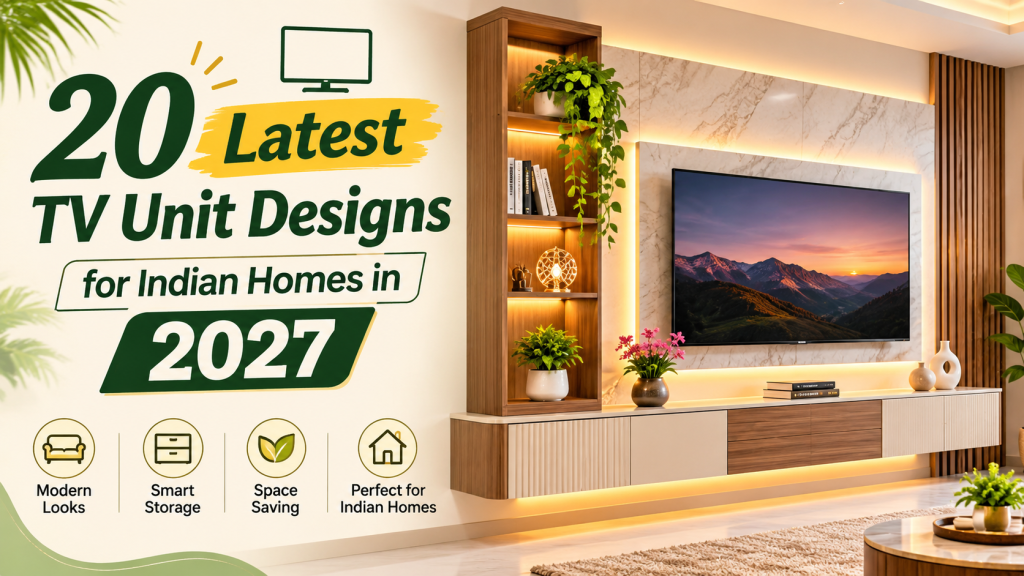
A TV unit is an important part of your living room. The latest TV unit designs for Indian homes in 2027 include floating cabinets, wooden panels, marble finishes, cement designs, hidden storage and simple wall-mounted units. These designs make your hall look beautiful while keeping your television, wires and other items organised.
Table of Contents
- What Are the Latest TV Unit Design Trends in 2027?
- 20 Latest TV Unit Designs for Indian Homes
- Simple TV Unit Design for Hall: Which One Should You Choose?
- TV Unit Designs for Living Room Based on Room Size
- TV Cabinet Designs for Living Room: Best Materials
- TV Unit Designs with Cement: Are They a Good Choice?
- How to Choose the Right TV Unit Design?
- Common Mistakes to Avoid
- Frequently Asked Questions
What Are the Latest TV Unit Design Trends in 2027?
The latest TV unit design trends in 2027 focus on simple looks, useful storage and natural colours. Indian homeowners are choosing floating cabinets, wooden wall panels, marble-look surfaces, open shelves and hidden storage. GroupDCA designs many TV units designs that are premium and luxury.
A good TV unit should match your room size, furniture and daily needs. It should also provide enough space for your television, router, set-top box and other items.
Here are some popular design features:
- Floating TV cabinets.
- Natural wooden finishes.
- Marble-look TV back panels.
- Vertical wooden slats.
- Hidden wire systems.
- Soft LED lights.
- Open display shelves.
- Floor-to-ceiling TV cabinets.
- Simple cement-look walls.
- Handleless storage drawers.
The best design is not always the most expensive one. A simple design can look beautiful when it matches your living room.
20 Latest TV Unit Designs for Indian Homes in 2027
Here are 20 modern TV unit designs for different Indian homes. These ideas include simple, modern, luxury, wooden and space-saving designs.
1. Simple Floating TV Unit Design
A floating TV unit is a good choice for modern Indian homes. It is fixed to the wall and does not touch the floor. This gives your living room a clean and open look.
You can choose a wooden or white floating cabinet with two or three drawers. Use the drawers to keep remote controls, cables and small items.
Best for: Small apartments, 1BHK and 2BHK homes.
Design tip: Keep the cabinet slightly wider than the television for a balanced look.
2. Modern Wooden TV Unit Design
Wooden TV units never go out of style. They add warmth and a natural feel to your living room.
You can use walnut, oak or teak-look finishes. Add a wooden panel behind the television and a matching cabinet below it.
This design works well with white, cream and beige walls. You can also add small open shelves for books and decorative items.
Best for: Homes with wooden furniture and warm interiors.
3. Marble Finish TV Unit Design
A marble-finish TV unit can give your living room a rich look. You can use a marble-look laminate, tile or decorative wall panel behind the television.
White marble patterns with grey lines look good with wooden cabinets. You can also use beige or dark marble finishes.
Real marble is not necessary. Marble-look surfaces can give a similar visual effect at a different cost.
Best for: Large living rooms and modern apartments.
4. TV Unit Design with Vertical Wooden Panels
Vertical wooden panels are a popular choice for modern living rooms. These panels create a simple pattern behind your television.
You can use narrow wooden strips with small gaps between them. Place a wall-mounted television in the centre and add a floating cabinet below it.
The vertical lines can make the wall appear taller.
Best for: Homes with modern furniture and simple wall colours.
5. TV Unit Design with LED Lights
LED lights can make your TV wall look more attractive. You can add soft lighting behind the TV panel, under the floating cabinet or inside open shelves.
Warm white lights are a good option for a comfortable living room. Avoid very bright lights behind the screen because they can distract you while watching television.
Best for: Modern flats and entertainment areas.
Design tip: Use hidden LED strips for a clean finish.
6. TV Unit Design with Cement Finish
Cement-look TV units are a good choice for people who like simple and industrial interiors.
You can use a cement-finish wall panel, textured paint or concrete-look tiles behind the television. Add a wooden floating cabinet to balance the grey colour.
This design looks good with black, brown and white furniture.
Best for: Modern apartments and industrial-style homes.
7. Floor-to-Ceiling TV Unit Design
A floor-to-ceiling TV unit uses almost the full height of a wall. It can include a TV panel, closed cabinets, open shelves and display sections.
You can keep the television in the centre and use the side sections for books, plants and decorative items.
This design gives you more storage space. However, it needs careful planning so that the room does not look crowded.
Best for: Large living rooms and spacious homes.
8. Minimalist White TV Unit Design
A white TV unit gives your living room a clean and fresh look. It works well with light walls and modern furniture.
Choose a white floating cabinet with handleless drawers. You can add a light wooden panel behind the television for some contrast.
White surfaces may show dust and marks more easily, so regular cleaning is important.
Best for: Small rooms and homes with light-coloured interiors.
9. TV Unit Design with Open Shelves
Open shelves are useful when you want to display books, photo frames, small plants and decorative items.
You can place two or three shelves on one side of the TV panel. Keep the other side simple to avoid a crowded look.
Do not fill every shelf. Leave some empty space for a clean appearance.
Best for: Families who like displaying books and home decor.
10. Modern TV Cabinet Design with Hidden Storage
A TV cabinet with hidden storage is useful for keeping your living room organised.
It can have closed drawers, handleless doors and hidden compartments. You can store remote controls, gaming accessories, cables and other small items inside.
Keep the router and electronic devices in a ventilated area. Do not block their air openings.
Best for: Families who want a clean and organised living room.
11. TV Unit Design with a Pooja Space
Many Indian families want a small pooja space near their living room. You can plan a TV unit with a separate side section for a small mandir.
Use a clear divider between the television area and the prayer area. Keep electrical wires away from the pooja space.
Make sure both sections have enough room and do not look crowded.
Best for: Indian homes where the living room also has a prayer area.
12. TV Unit Design with a Stone Finish
Stone-finish TV walls can add texture to your living room. You can use stone-look tiles, decorative panels or suitable natural stone.
Choose light stone finishes for a bright room. Dark stone finishes can create a strong look when paired with warm wooden cabinets.
Check the wall weight and installation needs before choosing heavy natural stone.
Best for: Contemporary and luxury-style homes.
13. Corner TV Unit Design for Small Rooms
A corner TV unit is a useful option when you do not have a large empty wall.
It makes use of an unused corner and leaves more space for other furniture. You can choose a small corner cabinet with shelves for your television accessories.
Check the viewing angle from your sofa before fixing the television.
Best for: Small living rooms and compact flats.
14. TV Unit Design with Glass Shelves
Glass shelves can give your TV wall a light and modern appearance.
You can use them to display small decorative items, photo frames and other lightweight objects. Choose strong safety glass with suitable wall supports.
Avoid placing heavy objects on glass shelves unless the shelves are designed to carry that weight.
Best for: Modern homes with simple interiors.
15. TV Unit Design with Two-Tone Colours
A two-tone TV unit uses two colours in one design. For example, you can combine white with walnut, beige with brown or grey with natural wood.
Use one colour for the main cabinet and another for the wall panel or shelves.
This design adds contrast without making the room look too colourful.
Best for: Homes that need a modern but balanced look.
16. TV Unit Design with Fluted Panels
Fluted panels have narrow raised lines on their surface. They add texture and depth to a plain TV wall.
You can use wooden, MDF or suitable decorative fluted panels. Pair them with a simple floating cabinet.
Choose a finish that matches your doors, flooring or other furniture.
Best for: Modern Indian living rooms.
17. Compact TV Unit Design with a Small Cabinet
A compact TV unit is useful when your living room has limited space.
Choose a small wall panel with one or two drawers. Keep the sides free and avoid adding too many shelves.
A simple design can make a small room feel more open. Measure the television and cabinet before installation.
Best for: Studio apartments, 1BHK homes and small halls.
18. TV Unit Design with a Study Table
If your home has limited space, you can combine a TV unit with a small study area.
Place the television on one side and add a study desk on the other side. Use shelves above the desk for books and work items.
Keep enough space between the television and the study area to make both sections comfortable to use.
Best for: Small apartments and work-from-home families.
19. Luxury TV Unit Design with a Backlit Panel
A backlit TV panel can create a beautiful focal point in a large living room.
You can use marble-look panels, wooden finishes or textured surfaces with soft lights behind them.
Keep the lighting gentle and avoid placing bright light directly behind the television screen.
Best for: Large halls and premium home interiors.
20. Modern TV Unit Design with a Full Wall Storage Cabinet
A full-wall TV cabinet combines television storage with bookshelves, display sections and closed cabinets.
You can use the centre section for the TV and side sections for other items. Keep the lower cabinets closed to hide clutter.
Choose matching colours and finishes to make the complete wall look balanced.
Best for: Large family living rooms with more storage needs.
Simple TV Unit Design for Hall: Which One Should You Choose?
A simple TV unit design for hall spaces should offer enough storage without taking up too much room.
You do not need a large cabinet to create a beautiful television wall. A small floating cabinet, a wooden panel or a simple wall-mounted shelf can work well.
Here is a simple comparison:
| TV unit design | Main benefit | Best room |
|---|---|---|
| Floating cabinet | Saves floor space | Small hall |
| Wooden panel | Adds warmth | Medium hall |
| White cabinet | Makes the room feel bright | Small apartment |
| Open shelves | Provides display space | Family hall |
| Compact cabinet | Uses less wall space | 1BHK home |
| Cement finish | Gives a modern look | Contemporary hall |
Simple design tip: Choose one main colour, one matching finish and only a few decorative items. This will help your hall look neat.
TV Unit Designs for Living Room Based on Room Size
Not every TV unit is suitable for every living room. Your room size, wall width and furniture layout should guide your choice.
TV unit designs for small living rooms
For small rooms, choose floating cabinets, compact wall panels and light colours.
Avoid very large storage units because they can make the room feel smaller.
TV unit designs for medium living rooms
Medium-sized rooms can use wooden panels, floating drawers and open shelves.
You can also add a small side cabinet for extra storage.
TV unit designs for large living rooms
Large rooms have more options. You can choose floor-to-ceiling units, marble-look panels and full-wall storage cabinets.
Make sure the TV wall matches the size of your sofa and other furniture.
| Room type | Suitable TV unit | Recommended feature |
|---|---|---|
| 1BHK | Floating TV unit | Small storage cabinet |
| 2BHK | Wooden panel unit | Drawers and shelves |
| 3BHK | Full-wall TV unit | Closed storage |
| Studio flat | Compact TV cabinet | Space-saving design |
| Large villa | Floor-to-ceiling unit | Display and storage sections |
TV Cabinet Designs for Living Room: Best Materials
The material you choose affects the look, strength, cost and life of your TV cabinet.
Before selecting a material, think about your budget, room conditions and maintenance needs.
1. Plywood
Plywood is made by joining thin layers of wood. It is commonly used for furniture and cabinets.
It can be a good option for TV cabinets because it offers useful strength and can hold screws well when the correct grade and thickness are selected.
2. MDF
MDF is made from fine wood fibres pressed together. It gives a smooth surface and is useful for painted and decorative designs.
It should be protected from moisture. Choose a suitable grade for the place where it will be used.
3. HDHMR Board
HDHMR stands for High Density High Moisture Resistance board. It is used for some types of interior furniture.
It can be useful for decorative cabinets, but the correct grade, edge sealing and installation are important.
4. Solid Wood
Solid wood gives a natural look and can last for many years with proper care.
However, it can cost more than many engineered wood options. It may also change slightly with temperature and moisture.
5. Laminate
Laminate is a surface finish used on furniture boards. It comes in many colours, textures and patterns.
You can choose wooden, marble-look, matte or glossy laminates for your TV unit.
6. Veneer
Veneer is a thin layer of natural wood fixed to a board. It gives furniture a real wood appearance.
It needs suitable polishing and care to maintain its finish.
| Material | Main benefit | Things to consider |
|---|---|---|
| Plywood | Good strength | Select the right grade |
| MDF | Smooth surface | Protect from moisture |
| HDHMR | Useful for selected furniture applications | Check board quality |
| Solid wood | Natural appearance | Needs care and a higher budget |
| Laminate | Many colours and finishes | Protect edges from damage |
| Veneer | Natural wood look | Needs proper polishing |
TV Unit Designs with Cement: Are They a Good Choice?
Yes, cement-look TV unit designs can be a good choice for Indian homes. They create a simple, modern and industrial appearance.
There are different ways to get this look.
Cement-finish wall
You can use cement-effect paint or a decorative wall finish behind your television.
It gives the wall a natural grey texture.
Concrete-look tiles
Concrete-look tiles can create a neat and modern television wall.
They are available in different shades and patterns.
Cement-look panels
Decorative panels can give your TV wall a concrete appearance without using a full concrete structure.
Cement and wood combination
You can combine a grey cement-look wall with a wooden floating cabinet.
The grey and brown colours create a balanced look.
Important: Do not assume that a decorative cement finish can support a television. The TV bracket must be fixed to a suitable wall structure with the correct fasteners.
How to Choose the Right Latest TV Unit Design for Your Home?
Choosing a TV unit is not only about its appearance. It should also fit your television, wall and daily needs.
Follow these simple steps.
1. Measure Your Wall
Measure the wall where you want to install your TV unit.
Check its height and width. Also measure the available space around doors, windows and other furniture.
2. Check Your TV Size
Check your television size before selecting the cabinet.
The cabinet should look balanced with the screen. Also make sure the TV bracket supports the television’s weight and size.
3. Plan Storage Space
Think about the items you want to keep inside the TV unit.
You may need space for:
- Set-top boxes.
- Wi-Fi routers.
- Gaming consoles.
- Remote controls.
- Speakers.
- Books.
- Decorative items.
4. Select the Right Colour
Choose a colour that matches your living room.
Wooden brown, white, beige and grey are useful choices for many Indian interiors.
5. Plan Cable Management
Plan the power points and cable routes before installation.
Use suitable cable channels or hidden wire systems. Keep enough space for repairs and changes.
6. Check Ventilation
Electronic devices can become hot during use.
Do not place routers, gaming consoles and other devices inside completely closed spaces without proper ventilation.
7. Choose Easy-to-Clean Materials
Your TV unit can collect dust every day.
Choose a surface that is easy to clean. Avoid too many small decorative gaps if you do not want extra cleaning work.
Important TV Unit Measurements for Indian Homes
There is no single correct measurement for every TV unit. The right size depends on the TV, wall, sofa and viewing position.
The following figures are starting points for planning, not fixed installation rules.
| Design element | Planning guidance | Why it matters |
|---|---|---|
| Floating cabinet depth | Around 30–45 cm | Allows useful storage |
| Open shelf depth | Around 20–30 cm | Holds small display items |
| Cabinet width | Wider than the TV where possible | Creates visual balance |
| TV screen height | Based on seated eye level | Helps comfortable viewing |
| TV viewing distance | Based on screen size and resolution | Supports comfortable viewing |
How high should a TV be mounted?
The TV should be placed at a comfortable height for people sitting on the sofa.
For many living rooms, the centre of the screen is close to seated eye level. The exact height depends on the screen size, sofa height and viewing position.
Avoid mounting the TV too high just to match the ceiling design.
How much space should be left around the TV?
Leave enough space around the television for ventilation, cleaning and access to cables.
Follow the television manufacturer’s instructions for ventilation and mounting.
Common Mistakes to Avoid While Choosing Modern TV Unit Designs
A beautiful TV unit can become difficult to use if it is not planned properly.
Avoid these common mistakes:
1. Choosing a Very Large Cabinet
A large cabinet can make a small living room look crowded. Select a size that matches your wall and furniture.
2. Ignoring Cable Management
Loose wires can make even a beautiful TV wall look untidy. Plan cable routes before installing the cabinet.
3. Not Checking Wall Strength
Do not mount a heavy television or cabinet on a weak wall without checking the wall structure.
Use suitable brackets and professional installation where needed.
4. Adding Too Many Shelves
Too many open shelves can collect dust and make the wall look busy.
Choose only the shelves you need.
5. Ignoring Ventilation
Set-top boxes, routers and gaming consoles need suitable airflow. Do not cover their air openings.
6. Choosing the Wrong Colour
A very dark or busy finish may not suit every room.
Look at your flooring, wall paint, curtains and sofa before choosing the final colour.
7. Ignoring Daily Use
Your TV unit should be easy to use. Keep remote controls, speakers and other devices in places where you can reach them easily.
Final Thoughts on the Latest TV Unit Designs for Indian Homes in 2026
The right TV unit can make your living room look organised, comfortable and beautiful. In 2027, floating cabinets, wooden panels, cement finishes, marble-look walls and full-wall storage units offer many choices for Indian homes.
Before choosing a design, measure your wall, check your TV size and plan your storage. A simple TV unit that meets your daily needs is often better than a large design that only looks attractive.
Choose a design that matches your home, budget and lifestyle.
Frequently Asked Questions About TV Unit Designs
1. Which TV unit design is best for Indian homes in 2027?
Floating TV units, wooden TV panels and cabinets with hidden storage are useful choices for Indian homes in 2027. They offer a clean look and help organise electronic items. Choose a design based on your room size, television size, storage needs and furniture style. A simple design is often enough for a small apartment.
2. Which TV unit design is best for a small hall?
A floating TV cabinet is a good choice for a small hall. It keeps the floor area clear and gives the room an open look. You can choose a compact cabinet with two drawers and a simple wall panel. Light colours such as white, beige and light wood can also make the room feel brighter.
3. What is the best material for a TV unit?
Plywood, MDF, HDHMR and solid wood are common choices for TV units. Plywood can offer good strength, while MDF provides a smooth surface for decorative finishes. Solid wood gives a natural look. The right material depends on your budget, design and room conditions. Always check the material grade and installation quality.
4. Are floating TV units good for Indian homes?
Yes, floating TV units are useful for many Indian homes. They save floor space and make cleaning easier. They also give the living room a neat appearance. However, the wall must be strong enough to support the cabinet. Use suitable brackets and professional installation to keep the unit secure and safe.
5. What is the ideal height for a TV unit?
The ideal TV unit height depends on your television size and sofa height. The centre of the television screen should generally be close to the eye level of people sitting on the sofa. Measure your seating position before installation. Avoid mounting the TV too high, as it may cause neck discomfort.
6. Which colour is best for a modern TV unit?
White, beige, walnut brown, grey and natural wood are useful colours for modern TV units. White and beige can make a small room look brighter. Wooden brown adds warmth, while grey gives a modern feel. Select a colour that matches your sofa, flooring, curtains and wall paint for a balanced appearance.
7. Are cement-finish TV units suitable for modern homes?
Yes, cement-finish TV units can suit modern and industrial-style homes. You can use cement-effect paint, concrete-look tiles or decorative wall panels. Grey cement finishes look good with wooden cabinets and black furniture. Check the wall structure before mounting your TV. A decorative cement finish alone may not support a heavy television.
8. How can I hide wires behind a TV unit?
You can hide TV wires using cable channels, wall conduits and planned wiring points. Keep power cables and other connections organised. Plan the cable route before installing the TV panel. Leave access for repairs and changes. Use a qualified electrician for electrical work, and never hide unsafe or damaged connections inside the wall.
9. What should I keep inside a TV cabinet?
You can keep remote controls, set-top boxes, gaming accessories, books and small electronic items inside a TV cabinet. Make sure electronic devices have enough ventilation. Do not block their air openings. Keep heavy objects on strong shelves and store small items in drawers. Organise cables to make cleaning and maintenance easier.
10. How do I choose the right TV unit size?
Start by measuring your wall and television. Then check the available space around your sofa, doors and windows. Choose a cabinet that looks balanced with the TV and offers enough storage. Check its depth, height and mounting requirements. Always plan for ventilation, cable access and comfortable viewing before installation.